Build a Memory Map: Remember What You Research with Spatial Recall
We remember places far better than we remember text. Ask someone to recall the layout of a house they lived in years ago and they can walk you through it room by room; ask them to recall a document they read last week and they'll struggle for a paragraph. A memory map exploits that asymmetry, turning research into something you remember by location instead of by rote.
The oldest memory trick there is
The method of loci — the "memory palace" — is over two thousand years old, and it works because human memory is spatial at its core. We evolved to navigate environments, so we have enormous capacity for remembering where things are. Mnemonists still use it to memorize absurd amounts of information by placing each item in an imagined location and mentally walking the route.
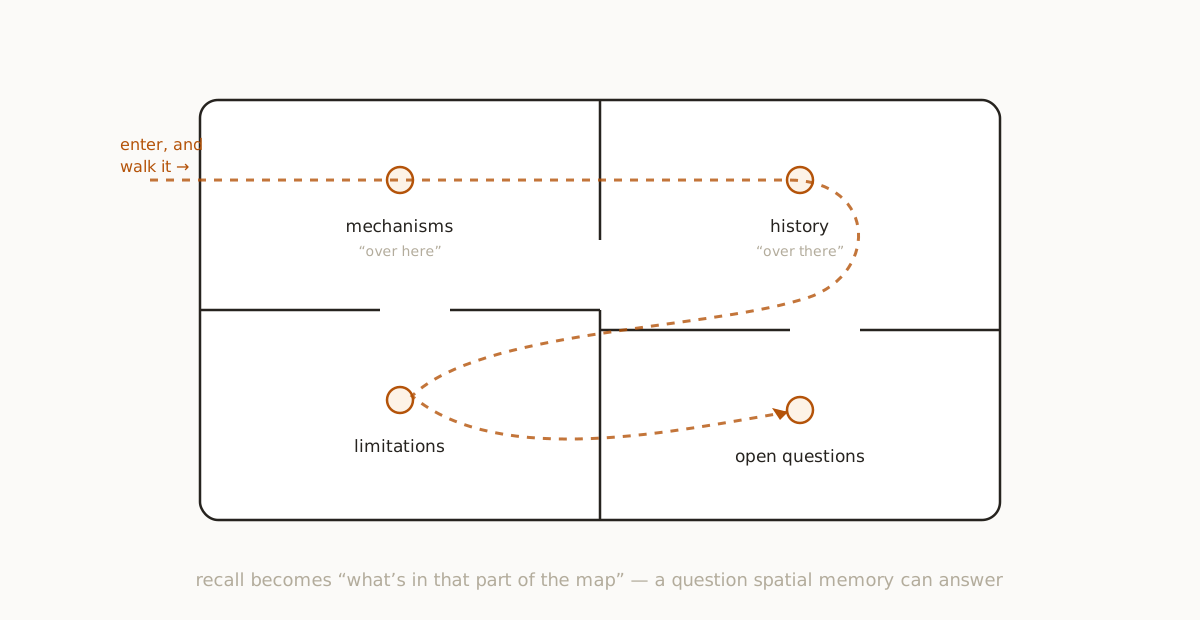
A memory map applies the same principle to research. Instead of a wall of notes, you build a spatial structure where each idea has a place. Recall stops being "what did that paragraph say" and becomes "what's in that part of the map" — a question your spatial memory is unusually good at answering.
Why a transcript is unrememberable
Contrast that with a chat log or a linear document. It has no geography. Every paragraph looks like every other paragraph; nothing has a location; there's nothing for spatial memory to grab. So the only way back in is to re-read it sequentially, and re-reading is slow and rarely happens. That's why so much AI research evaporates — not because the answers were bad, but because a transcript is fundamentally hard to remember.
A mind map, by contrast, gives every idea a position. The methodology stuff sits in one branch, the history in another. You start to remember the shape, and the shape is a handle on the content.
Building a memory map as you research
The trick is that you don't make the memory map as a separate study step — you build it while researching. Each question you ask becomes a node with a place. Each branch you follow extends the structure in a direction. By the time you're done, you haven't just gathered answers; you've built a spatial layout of the topic, and the act of building it has already started encoding it in memory.
This is where pairing the map with a language model matters. Because each node holds a real answer, the map isn't an empty diagram you have to mentally fill — it's full of content, positioned. You remember both the structure and what's in it, reinforcing each other.
Position plus participation
Two things make a memory map stick, and a good research workflow gives you both for free. The first is position — ideas have locations you can navigate. The second is participation — you built the structure yourself by choosing where to branch, and we remember what we construct far better than what we passively read. A memory map delivers both at once: every node is somewhere and it's there because you put it there.
That combination is why a researched map outperforms even a well-made set of flashcards for conceptual material. Flashcards drill isolated facts; a memory map preserves the relationships between them, which is what conceptual understanding actually consists of. (For drilling facts specifically, a memory map pairs well with the kind of review built into a good AI study tool.)
Keep it, and walk it again
The final ingredient is persistence. A memory map you can return to lets you do the spaced revisiting that cements long-term memory. Come back a week later, walk the structure, and the locations reload the content. Export it and it becomes a permanent part of your second brain — a place you can revisit rather than a session you have to reconstruct.
If you've ever finished a deep research session feeling like the knowledge ran straight through you, the missing ingredient was almost certainly geography. Give your research a place, build that place yourself, and what you learn will finally have somewhere to stay.
fork ai turns any question into a branching map you can explore, highlight, and keep. Try it free.
Start researching →