Build an AI Second Brain From Your Research
The "second brain" idea is appealing: an external store of everything you learn, so your actual brain is free to think instead of memorize. The problem is that most second brains become write-only — a beautifully organized graveyard of notes nobody ever reopens. An AI second brain built from your research can avoid that fate, but only if it's built around structure and retrieval rather than collection.
Why most second brains fail
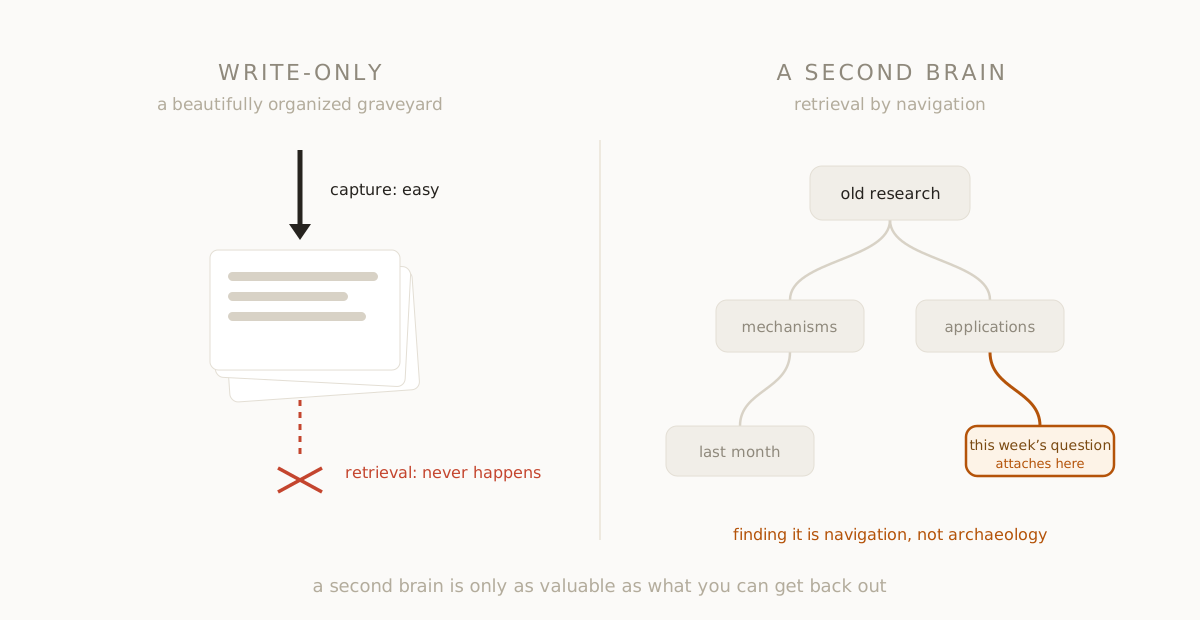
The standard second brain is a pile of documents and clippings. You capture diligently for a while, the folder grows, and then you realize you never read any of it. The reason is simple: capturing is easy and retrieving is hard. A note you saved six months ago is only useful if you can find it and understand it again quickly, and a heap of linear documents offers neither. The system optimized for getting information in and ignored getting it out.
A second brain is only as valuable as your ability to retrieve from it. Everything else is hoarding.
Structure is what makes retrieval possible
The fix is to store knowledge by structure, not by accumulation. Instead of documents in folders, you want a knowledge map: concepts as nodes, relationships as edges, everything connected to what it relates to. Retrieval stops being a search through a pile and becomes navigation through a structure — you go to where an idea lives and follow its connections.
This is also what lets the second brain compound. New research attaches to the relevant existing node rather than landing in a new isolated file. The map gets denser over time, and density — connections between things — is exactly what turns stored facts into usable understanding.
Where the AI actually helps
There are two distinct jobs an AI does in a second brain, and it's worth separating them.
The first is generation — producing the content that fills each node. This is the LLM doing what it's good at: explaining, summarizing, answering. It's how nodes get filled without you hand-writing every one.
The second is construction — the AI helping you build the structure as you research. When you branch a question, the new node slots into the map automatically, carrying its lineage. You're not filing; the structure forms as a byproduct of asking. This is the part that defeats the write-only problem: because building the map is the research, there's no separate, skippable step where you organize it later.
Build it by researching, not by filing
The healthiest second brain isn't something you maintain alongside your work — it's the residue of your work itself. Every research session, run as a branching workflow, leaves behind a map. Those maps are the second brain. You didn't file anything; you just researched, and the structure accumulated.
This matters because any system that requires discipline to maintain eventually loses to entropy. A second brain that builds itself as you think is the only kind that survives contact with a busy life.
Retrieval is the whole point
When you actually need something from a second brain, you want it fast and in-context. A map delivers both. Because each node remembers where it came from and what it connects to, finding last month's research on a topic is navigation, not archaeology — and once you're there, the surrounding structure reminds you how it all fit. You can extend it on the spot: branch a new question off old research and the new work connects to the old automatically.
That's also why persistence and export matter. A second brain you can keep across sessions and tools — revisit, search, build on — is a real asset. One that lives only inside today's chat window is a fiction.
Start small and let it grow
You don't build a second brain in a weekend; you grow one a session at a time. Do your next piece of real research as a map instead of a chat. Keep it. Do the next one, and let it connect to the first. Within a few weeks you'll have something genuinely useful: not a folder you avoid, but a structure you return to — a second brain that, unlike most, actually gets used.
fork ai turns any question into a branching map you can explore, highlight, and keep. Try it free.
Start researching →