From Prompt to Knowledge Map: A Workflow for Deep Research with AI
Most people do AI research the same way they'd interrogate a search box: type a question, skim the answer, type another question, repeat. It works for trivia. It falls apart the moment you're trying to actually understand something — because understanding isn't a list of answers, it's a structure. This is a workflow for turning a single prompt into a knowledge map you can keep.
Why the chat box is the wrong shape for research
A chat log is linear. You ask, it answers, you scroll. But real inquiry is a tree: one question opens three more, each of those opens a few of its own, and somewhere four levels down you find the thing you actually needed. When all of that gets flattened into one scrolling transcript, the structure — the part that made it understanding rather than trivia — is thrown away.
The cost shows up later. A week after a good research session you remember that you learned something, but not where it sat or how it connected. You can't navigate a transcript; you can only scroll it. Deep research with AI needs a medium that preserves shape.
The workflow, in five moves
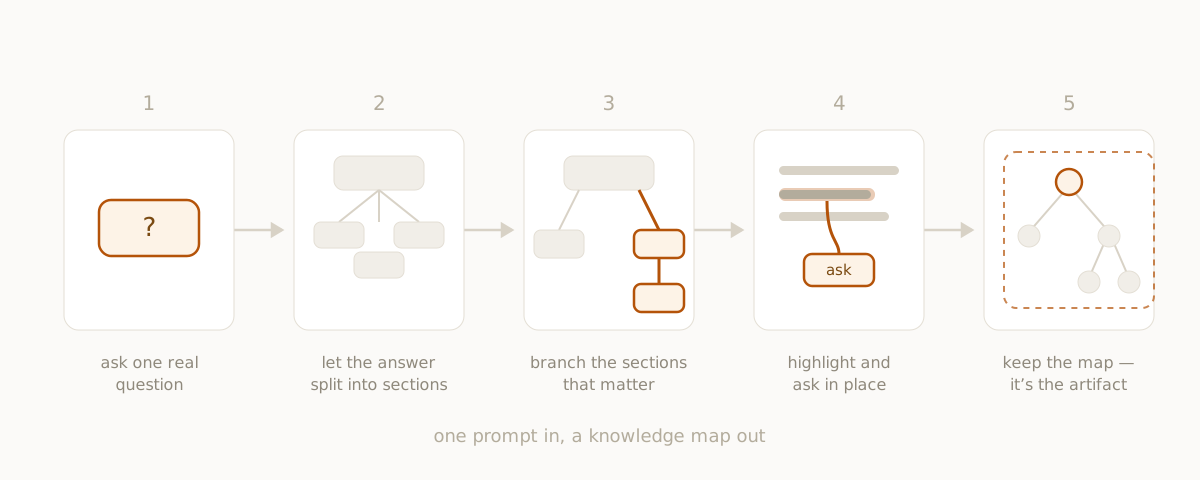
1. Start with one real question. Not a keyword — a question. "How do mRNA vaccines train the immune system?" gives a model something to structure an answer around. The broader and more genuine the question, the better the initial map.
2. Let the answer split into sections. A good research answer isn't a paragraph; it's a handful of distinct sub-topics. Treat each section as a door, not a conclusion. The mechanism section, the history section, the limitations section — each is a place you might go deeper.
3. Branch the sections that matter. This is the move that separates research from reading. When a section raises a question, branch from that section into its own node. You're not starting a new chat; you're growing a limb off the existing one, and the new node remembers where it came from.
4. Highlight and ask in place. Sometimes the question isn't about the whole section — it's about one sentence. Highlight it, ask your follow-up, and let the answer attach to that exact spot. The context travels with the highlight, so the model knows what "this" refers to.
5. Keep the map. At the end you don't have a transcript — you have a knowledge map: a branching structure where every node is something you asked and every edge is a reason you asked it. That map is the artifact worth saving.
Breadth first, then depth
A common failure mode is tunnelling: you follow the first interesting thread straight to the bottom and never come back up. The map fixes this by making breadth visible. Before you dive, let the top-level answer lay out the whole territory — four or five sections that cover the field. Then choose where to go deep, knowing what you're skipping.
This is the same instinct behind a literature review done with AI: map the field first, so depth is a choice rather than an accident.
Why structure beats summary
You could ask a model to "summarize everything about X" and get a tidy paragraph. But a summary is someone else's compression of the topic. A map is yours — it records the specific questions you asked, in the order your curiosity asked them. That provenance is what makes it stick. When you can see that you went from "how does it work" to "why does it fail" to "what's the workaround," you're not just holding facts; you're holding the reasoning that connects them. That's also why a branching map is far easier to remember later than a wall of text.
The model is the engine, not the workspace
It's worth being precise about what the AI is doing here. The large language model generates the content of each node — the answer, the sections, the follow-ups. But the workspace is what holds the structure: which node came from which, what you highlighted, where you branched. The model is the engine; the map is the vehicle. Confusing the two is why pure chat feels powerful in the moment and useless a week later — it has the engine but no vehicle to keep what the engine produced.
This is also the bridge between AI and the older tradition of mind-mapping for research: the mind map gave us the structure, the LLM gives us the content, and putting them in one workspace is what makes deep research feel fast.
Putting it to work
Try it on your next real question — something you'd actually like to understand, not just look up. Ask it once. Watch the answer split. Branch the two sections that pull at you, and branch again from there. In ten minutes you'll have a small tree that holds more genuine understanding than an hour of scrolling a chat would. That tree is the point. The answers are just what fills it in.
fork ai turns any question into a branching map you can explore, highlight, and keep. Try it free.
Start researching →