Mind Maps Meet LLMs: Visual Thinking for AI-Assisted Learning
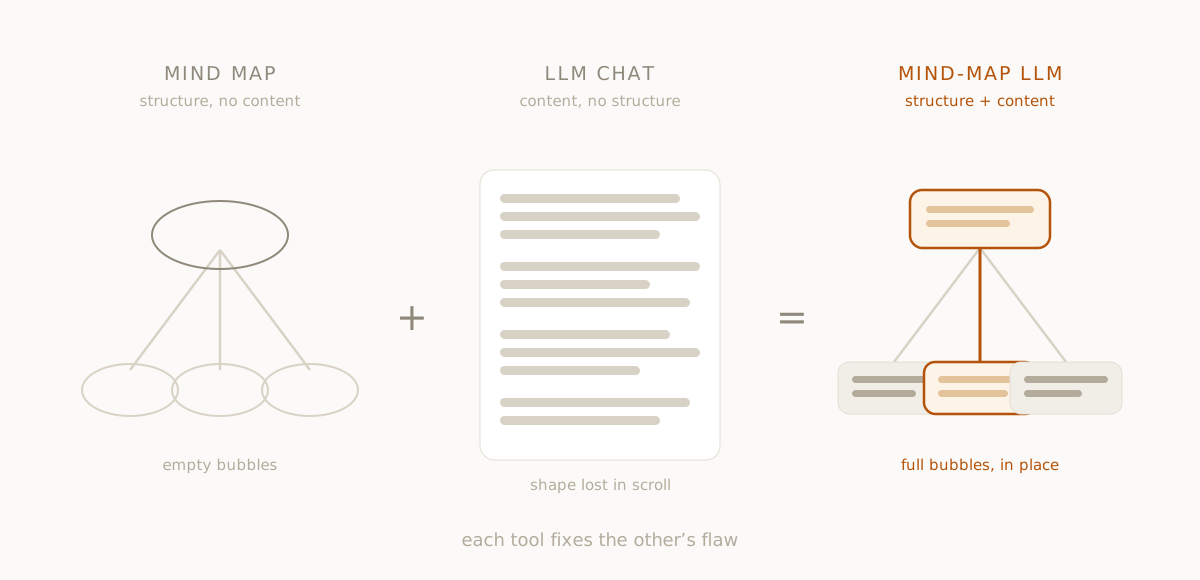
Mind maps and large language models solve opposite halves of the same problem. A mind map gives you structure with no content — empty bubbles waiting to be filled. An LLM gives you content with no structure — endless answers poured into a scrolling column. Put them in the same workspace and each fixes the other's flaw. That's the whole idea behind a mind-map LLM.
Two tools, opposite weaknesses
A traditional mind map is wonderful at showing how ideas relate. You can see the whole topic at a glance, follow branches, grasp the shape. But the nodes are just labels. The map points at knowledge; it doesn't contain it.
A language model is the reverse. Ask it anything and it produces a thorough, well-organized answer — genuine content, on demand. But the default chat interface has no structure. Every answer lands at the bottom of one column, and the relationships between answers vanish into scroll. The content is rich; the shape is gone.
The complementarity is almost too neat. One has structure and wants content. The other has content and wants structure.
What happens when you combine them
In a mind-map LLM workspace, every node on the map is backed by the model. The central node holds the answer to your first question. Branch a sub-topic and the model fills the new node with its answer. Highlight a passage, ask a follow-up, and a child node appears holding the response — connected, in the map, to exactly where it came from.
You're navigating a mind map, but the bubbles are full. You're talking to an LLM, but the answers have a place to live. Visual thinking and generative AI stop being separate activities and become one motion: ask, see it appear as a node, branch from it, repeat.
Why this is better for learning
AI-assisted learning gets a bad reputation when it means passively reading whatever a chatbot emits. A mind-map LLM flips that. Because you're the one deciding where to branch, you stay active — every node is a choice you made about what to explore next. The map externalizes your understanding as you build it, which is exactly the condition under which learning sticks.
It also engages spatial memory. When the photosynthesis explanation lives in a specific spot on a map you built, you remember it partly by location — the same trick that makes a memory map so durable. A flat transcript offers nothing for spatial memory to grab.
The structure carries the context
There's a practical payoff too. Because each node knows its place in the map, the model can be given exactly the right context for each question. Branch from the "limitations" section and the follow-up inherits that lineage — not the entire undifferentiated conversation. Tighter, more relevant context means sharper answers. This is the same advantage that makes branching AI conversations outperform linear ones: the shape of the map is a context-management system.
From diagram to instrument
The thing that makes this more than a novelty is that the map becomes a real artifact. A hand-drawn mind map is made once and abandoned. A mind-map LLM grows with every question and is worth keeping — a structured record of an inquiry you can return to, extend, or export. The diagram becomes an instrument; the instrument becomes part of how you think.
If you've used mind-mapping software and found the empty nodes tedious, or used AI chat and found the lost structure frustrating, you've felt both halves of the problem. Putting the LLM inside the map — as part of a deliberate research workflow — is what makes the two finally click together.
fork ai turns any question into a branching map you can explore, highlight, and keep. Try it free.
Start researching →