Beyond Linear Chat: Why Branching AI Conversations Win
Every mainstream AI chat interface has the same shape: a single column of messages, oldest at top, newest at bottom. It's familiar because it's how text messaging works. But research and serious thinking aren't text messaging, and the linear chat quietly sabotages them. Branching AI conversations fix the shape — and once you've worked in one, the single column feels like a straitjacket.
The tyranny of the single thread
In a linear chat, every question you ask shares one timeline. That creates two problems at once.
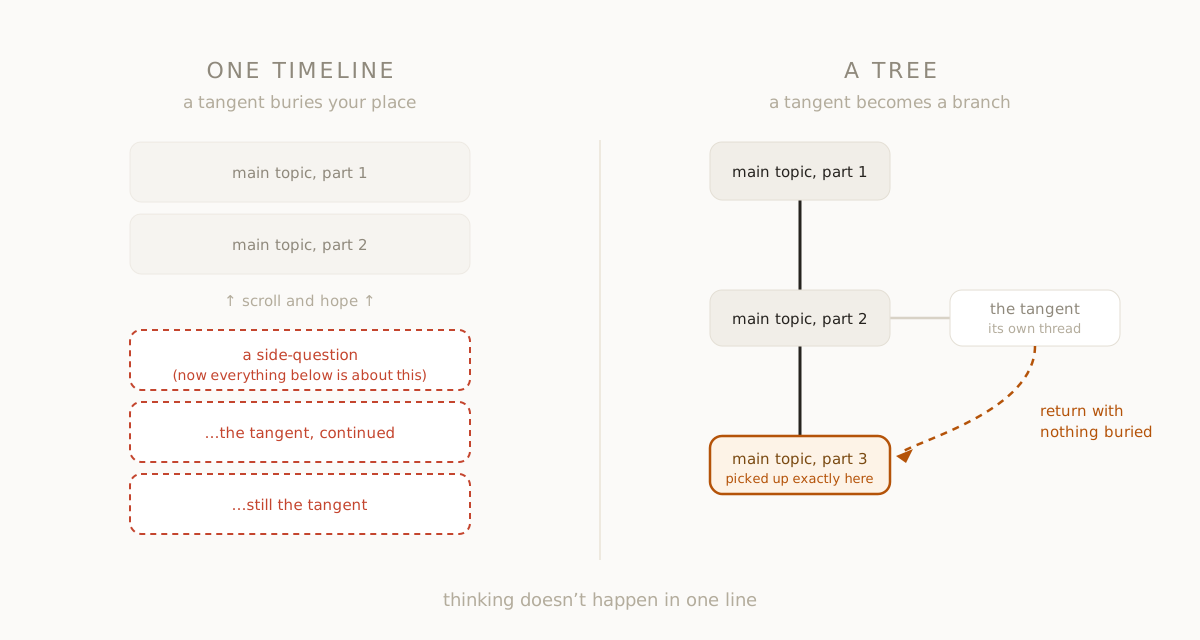
First, tangents destroy your place. You're three questions deep on a topic, a side-question occurs to you, you ask it — and now the main thread is buried above a detour you may not even have wanted. To get back you scroll and hope.
Second, context gets muddy. The model sees the whole conversation as context, so your careful deep-dive on one sub-topic gets blended with the unrelated tangent you took five messages ago. The answers get vaguer as the thread gets longer, because the relevant context is drowning in irrelevant history.
A single thread forces everything into one line. But thinking doesn't happen in one line.
What branching changes
A branching conversation lets any message spawn its own thread. Ask a question, get an answer, and from that answer launch a new branch for the follow-up — while the original stays exactly where it was. Tangents become branches instead of interruptions. You can explore one fully, then return to the trunk and take a different branch, with nothing buried and nothing lost.
The result is a tree of conversation instead of a transcript. And a tree is navigable: you can see all the threads at once, jump to any of them, and understand at a glance how they relate. This is the same structure behind mind-map research — branching isn't a chat feature, it's the natural shape of inquiry.
Branching is also better context management
The subtler win is about context. When a branch carries its own lineage — the specific chain of questions that led to it — the model can be given exactly the right context for the question at hand, rather than the entire undifferentiated history. Branch from the "limitations" discussion and the follow-up inherits that, not the tangent from earlier.
Tighter context produces sharper answers. So branching doesn't just keep you organized; it makes the LLM itself perform better, because you're feeding it relevance instead of noise. The structure of the conversation becomes a context-management system you get for free.
Highlight-level branching
The most precise form of branching starts not from a whole message but from a single passage. Highlight one sentence in an answer, ask about that, and a child thread opens with the sentence as its subject. Now the model knows exactly what "this" refers to, and the new thread is anchored to the precise spot that prompted it. Linear chat can't do this at all — there's nowhere for a sentence-level follow-up to go except the bottom of the pile.
From conversation to artifact
Here's the payoff that outlasts the session. A linear chat is disposable — you'll never scroll it again. A branching conversation is an artifact: a structured map of an inquiry, with every thread in its place and every branch recording why you asked. You can navigate it, extend it later, and keep it as part of a growing second brain.
That's the real case for branching. It's not a nicer way to chat; it's a different medium — one whose shape matches how research actually works, and whose output is something worth saving. If linear chat has ever left you with a vague sense that you learned a lot but can't find any of it, the format was the culprit. Give the conversation a structure and the same questions produce something you can keep.
fork ai turns any question into a branching map you can explore, highlight, and keep. Try it free.
Start researching →