Mind Map Research: Why Linear Notes Fail and Branching Wins
Open any researcher's notes and you'll usually find the same thing: a long, linear document. Heading, paragraph, heading, paragraph, scrolling down into the dark. It's how we've taken notes since notebooks were literally books. But research doesn't think in lines — it thinks in branches. Mind map research is about closing that gap.
What linear notes throw away
Linear notes impose an order that the research didn't have. You learned things in a tangle — this connected to that, which reminded you of a third thing — but the notes flatten it into a sequence, because a document can only go top to bottom. The connections, the side-questions, the "wait, how does this relate to the earlier point" — all the structure that made it understanding rather than a list — gets dropped on the floor.
The damage is invisible until later. When you return to linear notes, you can re-read them but you can't navigate them. There's no map, only a path. And a path only tells you the order you walked, not the shape of the place.
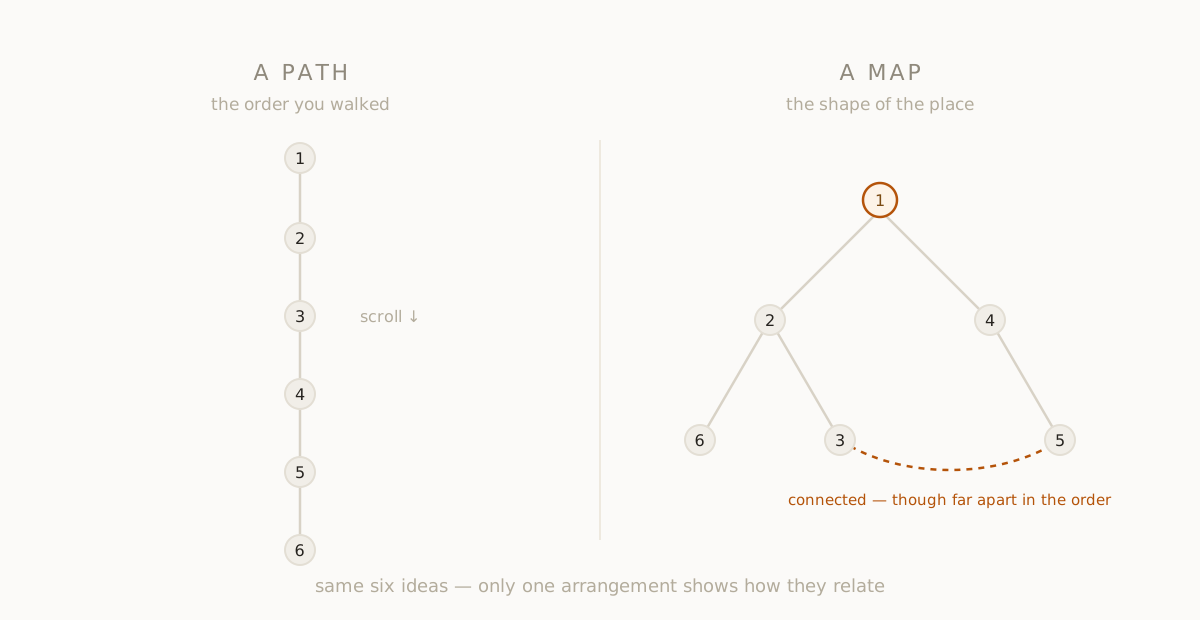
A mind map keeps the shape
A mind map is just notes that admit research is a tree. A central question sits in the middle. Sub-topics branch off it. Each sub-topic branches again. The structure on the page mirrors the structure in your head — and crucially, it's spatial. Ideas have locations. The methodology stuff is over here; the historical context is over there.
That spatial structure is what makes a mind map navigable. You don't scroll to find something; you go to where it lives. This is also why mind maps are easier to remember — your spatial memory does work that your verbal memory can't, a property worth exploiting deliberately with a memory map.
Where traditional mind maps fall short
For all their strengths, hand-drawn mind maps have a real limitation: the nodes are empty. A bubble that says "photosynthesis — light reactions" is a pointer to knowledge you don't actually have written down. The map captures structure but not content. You still have to go find the explanation somewhere else, which is why mind maps often end up as pretty diagrams you make once and never use.
The fix isn't to abandon the map. It's to fill the nodes with real content — and that's exactly what becomes possible when you put a language model behind every branch.
Mind map research, with an engine behind it
Imagine a mind map where each node isn't a label but a full answer. You ask a question; the map's central node fills with a structured response. You branch a sub-topic; the new node fills with its answer. The structure is the mind map you always wanted; the content is generated on demand. That combination — visual structure plus an LLM behind each node — turns the mind map from a static diagram into a living research instrument.
Now the map isn't a pointer to knowledge elsewhere. It is the knowledge, organized spatially, grown one question at a time. This is the heart of a structured AI research workflow: branch where your curiosity pulls, and let each branch fill itself in.
Branching beats bullet points
Why does this win over a well-organized linear document? Three reasons:
- Non-linear capture. You can follow a tangent without destroying your place. The tangent becomes a branch, not an interruption.
- Visible breadth. The map shows everything at once — what you've explored and what you've skipped. A document hides everything except the part you're scrolled to.
- Durable structure. The shape of the map is the record of your reasoning. Months later it tells you not just what you learned but how the pieces connect.
Bullet points can list facts. Only a branching structure can hold relationships, and relationships are what research is actually made of.
Try it on a real question
The next time you'd open a blank document to "take notes on" something, try mapping it instead. Put your real question at the center. Let it branch. Follow the branches that pull at you and watch a structure emerge that no linear outline could have planned. You'll end with something better than notes — a map of a topic, in the shape your own curiosity gave it.
fork ai turns any question into a branching map you can explore, highlight, and keep. Try it free.
Start researching →