Knowledge Maps vs Linear Notes: Organizing What You Learn
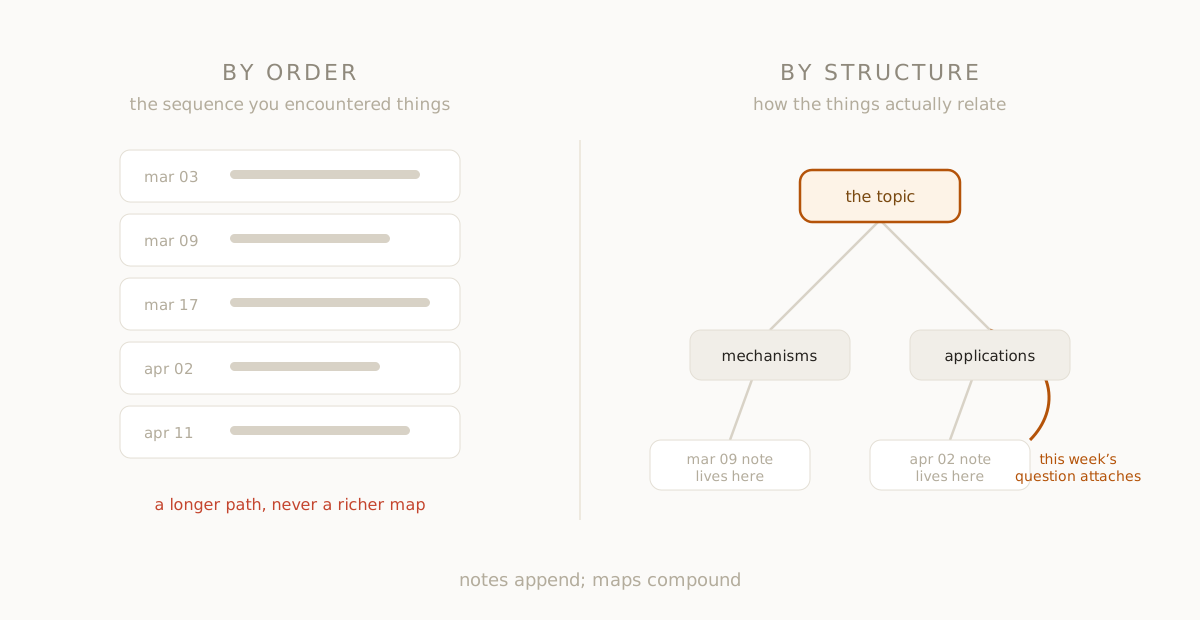
There are two ways to organize what you learn: by order or by structure. Linear notes organize by order — the sequence you happened to encounter things. A knowledge map organizes by structure — how the things actually relate. For anything you want to keep and build on, structure wins, and it isn't close.
Order is an accident; structure is the point
When you take notes top to bottom, the organizing principle is time: this came before that. But the order you learned something in is mostly arbitrary. It tells you nothing about which ideas are central, which depend on which, or how the whole thing fits together. You've recorded a path through the topic, not a map of it.
The trouble is that paths don't compose. Add next week's notes and you get a longer path, not a richer map. Knowledge accumulates as a pile of documents you'll never reread, because re-reading a path is as slow as walking it the first time.
What a knowledge map is
A knowledge map organizes information by how it connects. Concepts are nodes; relationships are edges; the whole thing is navigable by structure rather than by scroll. Want the part about mechanisms? Go to where mechanisms live on the map. Want to see how two ideas relate? Follow the edge between them. The map is spatial and relational, which is how human understanding is actually organized — and why a map is so much easier to remember than a transcript.
It's the natural endpoint of both mind-mapping and concept-mapping: a persistent structure that holds not just what you learned but how the pieces fit.
Why maps compound and notes don't
Here's the property that makes a knowledge map worth the effort: it compounds. New research doesn't append to the bottom — it attaches to the relevant place. Today's question about a sub-topic branches off the node you created for it last month. The map gets denser and more connected over time instead of just longer. That density is what turns a collection of facts into genuine expertise: not more notes, but more connections between them.
This is exactly why a knowledge map is the foundation of a second brain. A second brain isn't a folder of documents; it's a structure that gets more valuable the more you put in it, because everything you add is connected to everything related.
Building one without the busywork
The classic objection to knowledge maps is that maintaining them is work. You have to decide where each new thing goes, draw the links, keep it tidy. For hand-built systems that overhead is real, and it's why most people give up.
AI changes the economics. When the content of each node is generated on demand and the structure forms from the questions you ask, the map builds itself as a byproduct of researching. You're not maintaining a map in addition to doing the work — the map is the work, captured in a useful shape. Follow a real research workflow — ask, branch, keep — and a knowledge map accumulates without any separate filing step.
Navigable, durable, yours
A good knowledge map has three properties a stack of notes lacks. It's navigable: you find things by structure, not by scrolling. It's durable: export it and it survives the session, ready to extend next time. And it's yours: it records the specific questions you asked, so it reflects your understanding rather than a generic summary.
If your "notes" are really a graveyard of documents you never reopen, the problem isn't discipline — it's shape. Notes are the wrong container for knowledge you want to keep. A map is the right one. Start mapping your next topic instead of noting it, and watch what you learn finally begin to add up.
fork ai turns any question into a branching map you can explore, highlight, and keep. Try it free.
Start researching →