fork ai vs NotebookLM: Document Q&A vs a Branching Map
NotebookLM is one of the most genuinely useful AI tools Google has shipped: point it at your own documents and it answers questions grounded only in those sources, with citations back to the page. For making sense of material you already have — a stack of PDFs, a dense report, your own notes — it's excellent. But "answer questions about these documents" is a different job from "explore an open question and build a structure as you go." Here is an honest comparison for people deciding which one fits the work in front of them.
The short version
| NotebookLM | fork ai | |
|---|---|---|
| Core job | Q&A grounded in your uploaded sources | Explore any question into a branching map |
| Starting point | Documents you bring | A question you ask |
| Answer shape | Cited answers from your sources | Sectioned answers, each section branchable |
| Follow-ups | Linear chat over the sources | Open a branch with its own context lineage |
| Structure of the inquiry | Notes / chat, not a map | Live mind map of every branch |
| Standout feature | Source grounding, Audio Overviews | Branching exploration you keep |
| Export | Copy / save notes | One-click to Notion or PDF, structure intact |
| Models | Gemini | Claude, Gemini, DeepSeek, GLM — per branch |
Where NotebookLM genuinely wins
If you already have the material, NotebookLM is superb. It grounds every answer in your sources and cites the exact passage, which makes it trustworthy for summarizing documents, querying a corpus, and avoiding hallucination. Its Audio Overview — a generated podcast-style discussion of your docs — is a legitimately novel way to absorb material. For "help me understand these specific documents," fork ai is not the tool.
Where document Q&A stops short
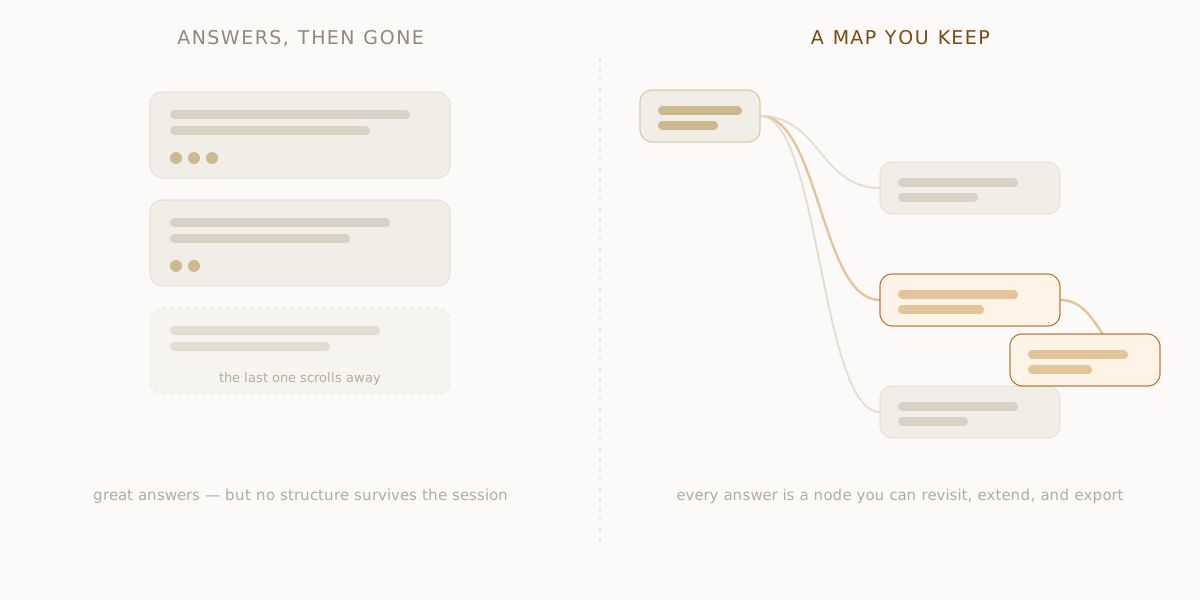
NotebookLM's strength is also its boundary: it works within the sources you give it. Open-ended research often starts before you have any sources — you're trying to map a field you don't know yet, and the questions multiply faster than you can read. And even inside a notebook, the exploration itself is a linear chat: ask, answer, ask again. The structure of what you're learning — how the sub-topics relate, which thread you were chasing — isn't captured as anything navigable. You get grounded answers, but no map of the inquiry, and nothing that branches.
How fork ai is different
fork ai is built for the open phase of research — before and beyond a fixed set of documents. You ask a question and get an answer split into sections; from any section you "Go deeper" into a child node, or highlight a passage and "Ask AI" to branch a follow-up anchored to that exact phrase. Every branch becomes a node on a live mind map, so a topic becomes a structure you can see and navigate — the difference between a knowledge map and linear notes.
Because each branch carries its own lineage, context stays clean and answers stay sharp as you go deeper. And the map is durable: a session exports to Notion or PDF and becomes part of a growing second brain — the kind of research assistant that doesn't lose the thread. When you do want sources, web search toggles on per branch with citations.
When to use which
Use NotebookLM when you already have the documents and want grounded, cited answers about them (or a great audio summary). Use fork ai when you're starting from a question, mapping an unfamiliar field, and want the exploration to become something structured you keep. They pair well: explore and structure a topic in fork ai, then drop your gathered sources into NotebookLM to go deep on the specifics.
FAQ
Is fork ai a NotebookLM alternative? For open-ended exploration you want to map and keep, yes. For grounded Q&A over documents you already have, NotebookLM is excellent — the two are complementary.
Does fork ai work with my own documents? fork ai is built around exploring questions into a branching map rather than querying an uploaded corpus; for source-grounded document Q&A, NotebookLM is the better fit.
What does fork ai do that NotebookLM doesn't? It branches each answer into its own context-isolated thread and renders the whole inquiry as a live, keepable mind map you can export.
Which models does fork ai use? Your choice of Claude, Gemini, DeepSeek, or GLM per branch, with Claude Sonnet for the root question.
fork ai turns any question into a branching map you can explore, highlight, and keep. Try it free.
Start researching →