fork ai vs ChatGPT: Which Is Better for Research?
ChatGPT is the default AI tool for almost everyone, and for good reason — it is fast, fluent, and astonishingly general. But "ask a question, get an answer" is a different job from "research a topic and keep what you learn." If you have ever finished a long ChatGPT session feeling like you understood a lot but couldn't find any of it the next day, the problem wasn't the model. It was the format. Here is an honest comparison for anyone using AI to actually research, not just to ask.
The short version
| ChatGPT | fork ai | |
|---|---|---|
| Answer shape | One running message thread | Structured sections, each branchable |
| Follow-ups | Added to the bottom of one timeline | Open a new branch that keeps its own context |
| Context handling | Whole conversation fed back in; degrades as it grows | Each branch inherits only its own lineage |
| Tangents | Bury your place in the thread | Become their own node, trunk untouched |
| What you keep | A transcript you'll never scroll again | A navigable mind map of the whole inquiry |
| Visualization | None | Live mind map of every branch |
| Export | Copy-paste | One-click to Notion or PDF, structure intact |
| Models | OpenAI models | Claude, Gemini, DeepSeek, GLM — per branch |
Where ChatGPT genuinely wins
Credit where it's due. ChatGPT is the best general-purpose assistant available: drafting, coding, brainstorming, quick factual answers, and open-ended conversation. Its ecosystem — custom GPTs, voice, image generation, a mature mobile app — is far broader than any focused tool. If your task is "help me write this email" or "explain this error," a linear chat is exactly the right shape, and fork ai is not trying to replace that.
Where the linear thread fights your research
Research is not one question. It's a question that spawns five more, each of which spawns more. A single message thread forces all of that into one line, and two things break.
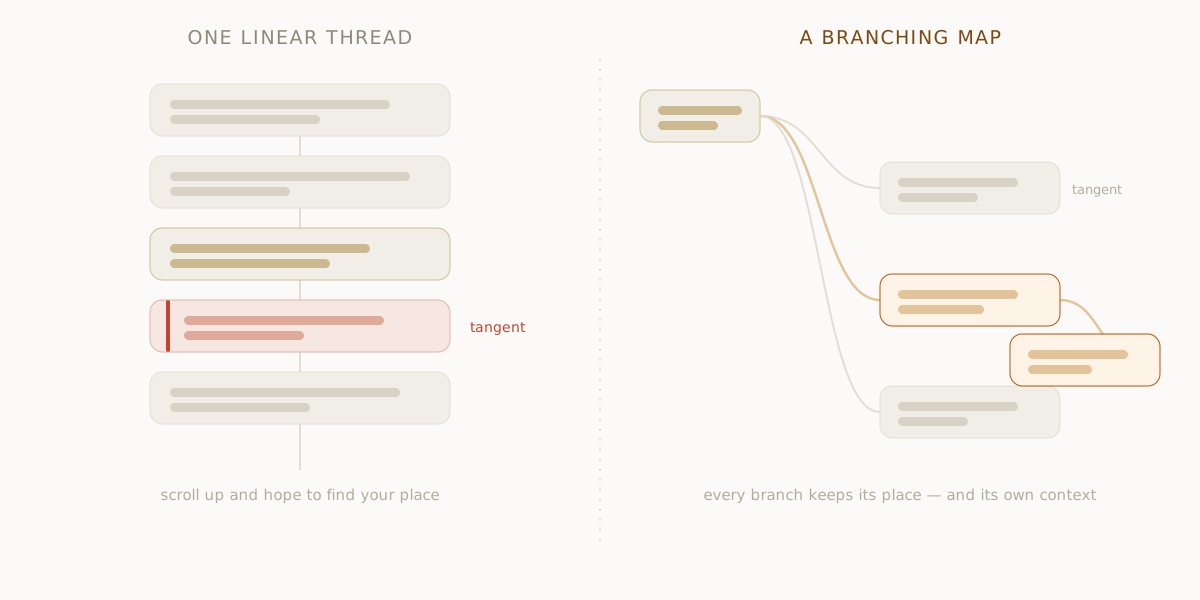
First, tangents destroy your place. You're deep on one sub-topic, a side question occurs to you, you ask it — and now your main thread is buried above a detour. To get back you scroll and hope.
Second, context gets muddy. ChatGPT sees the whole conversation as context, so a careful deep-dive blends with the unrelated tangent from ten messages ago, and answers get vaguer as the thread gets longer. This is the lost-in-the-middle problem: more history is not more understanding. This is the core case for branching AI conversations over a single column.
How fork ai is different
fork ai starts where ChatGPT stops. You ask a question and get an answer split into sections rather than one block of prose. From any section you can "Go deeper" — opening a child node — or highlight a single passage and "Ask AI" to branch a follow-up anchored to exactly that sentence. Every branch becomes a node on a live mind map, so the shape of your thinking is visible and navigable instead of scrolling away.
The subtler win is context. Because each branch carries its own lineage — the specific chain of questions that led to it — the model gets exactly the right context for the question at hand, not the entire undifferentiated history. Tighter context produces sharper answers, so the structure isn't just for you; it makes the LLM itself perform better.
And the session outlives the session. A ChatGPT thread is disposable; a fork ai map is an artifact you can revisit, extend later, export to Notion, and grow into a second brain.
When to use which
Use ChatGPT for quick answers, drafting, coding, and open-ended conversation. Use fork ai when a question is big enough to branch — literature reviews, learning a new field, comparing options, anything you want to keep. Many people use both: ChatGPT for the quick stuff, fork ai when they need the map.
FAQ
Is fork ai a ChatGPT alternative? For research and learning, yes — it's built for branching exploration you keep. For general chat, coding, and drafting, ChatGPT remains excellent and the two complement each other.
Does fork ai use GPT? fork ai runs branch answers on your choice of Claude, Gemini, DeepSeek, or GLM, with Claude Sonnet for the root question. You pick the model per branch.
Can I export my research out of fork ai? Yes — any session exports to Notion as a structured page or to PDF, with the branching structure preserved.
What does fork ai do that ChatGPT can't? Branch any answer into its own context-isolated thread, see the whole inquiry as a live mind map, and keep that map as a durable, navigable artifact.
fork ai turns any question into a branching map you can explore, highlight, and keep. Try it free.
Start researching →