fork ai vs Perplexity: Answer Engine or Research Workspace?
Perplexity reset everyone's expectations for AI search: ask anything, get a synthesized answer with real citations, in seconds. As an answer engine it is excellent. But an answer engine and a research workspace solve different problems. Perplexity is built to end your search quickly; research is the part that begins after the first good answer — the follow-ups, the tangents, the structure you build. Here is an honest comparison for people who don't just want an answer, they want to keep building on it.
The short version
| Perplexity | fork ai | |
|---|---|---|
| Core job | Answer a question from the live web | Explore a topic into a structured map |
| Answer shape | One cited answer, then the next | Sectioned answer, each section branchable |
| Follow-ups | Continue a linear thread / Space | Open a branch with its own context lineage |
| Structure that survives | A list of past answers | A navigable mind map of the whole inquiry |
| Web citations | Yes — its core strength | Optional web search per branch, with sources |
| Visualization | None | Live mind map of every branch |
| Export | Copy / share a thread | One-click to Notion or PDF, structure intact |
| Models | Multiple, behind one answer | Claude, Gemini, DeepSeek, GLM — you choose per branch |
Where Perplexity genuinely wins
Perplexity is the best tool for "what's the current answer to this?" Its live web grounding and inline citations make it fast and trustworthy for facts, news, product research, and quick verification. If your goal is to get a sourced answer and move on, Perplexity is hard to beat, and fork ai isn't trying to out-search it.
Where the answer engine stops short
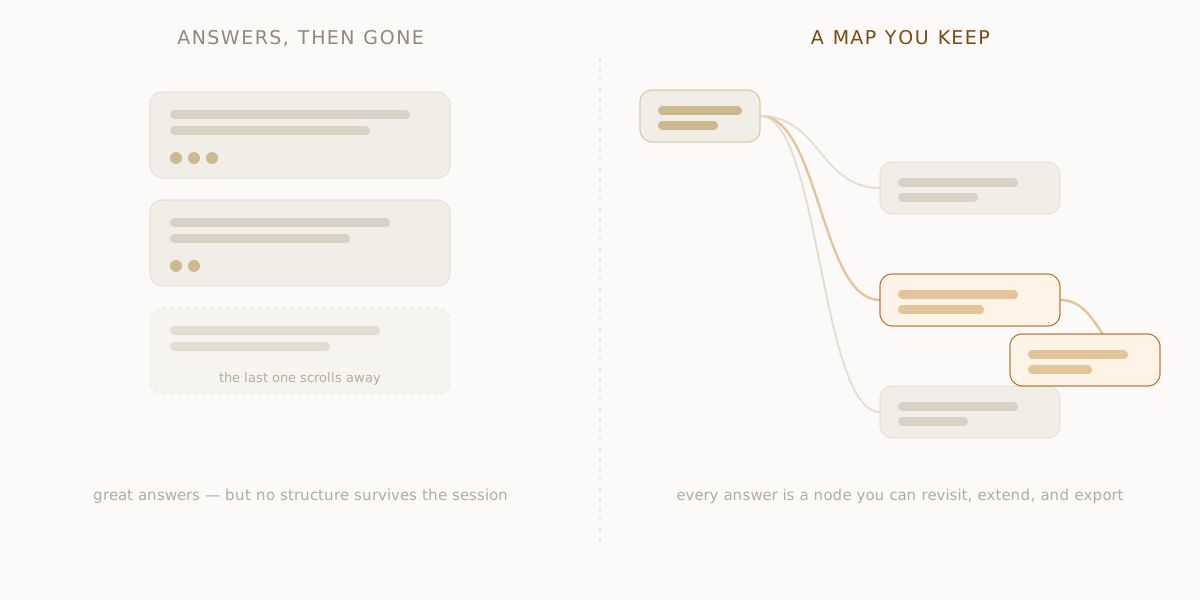
The answer engine model optimizes for ending the search. But real research is recursive: a good answer raises three new questions, and you want to chase each without losing the others. In a linear thread — even inside a Perplexity Space — those follow-ups stack into one timeline. The structure of your inquiry lives only in your head, and when the session ends, it's gone. You're left with a pile of good answers and no map of how they fit together — answers, then gone.
How fork ai is different
fork ai treats the first answer as a starting point, not a destination. Your question returns an answer split into sections; from any section you "Go deeper" into a child node, or highlight a passage and "Ask AI" to branch a follow-up anchored to that exact phrase. Every branch becomes a node on a live mind map, so a topic you're exploring becomes a structure you can see — not a chat log you scroll.
Two consequences follow. First, context stays clean: each branch carries only its own lineage, so the model answers the sub-question with the right context instead of the whole history. Second, the work is keepable — a fork ai session exports to Notion or PDF and grows into a second brain, where a Perplexity thread is something you rarely reopen.
fork ai still does web search when you want it — toggle it per branch and answers come back with sources — so you don't give up citations to get structure.
When to use which
Use Perplexity to get a fast, sourced answer to a specific question. Use fork ai when one answer isn't the end — when you're mapping a field, weighing options, or learning something you intend to keep. A common workflow: Perplexity to find the fact, fork ai to build the understanding around it.
FAQ
Is fork ai a Perplexity alternative? For open-ended research you want to keep and structure, yes. For quick web-sourced answers, Perplexity is excellent — many people use both.
Does fork ai cite its sources? When web search is enabled on a branch, answers come back with sources/footnotes. Web search is optional per branch.
What does fork ai do that Perplexity doesn't? It branches each answer into its own thread, shows your whole inquiry as a live mind map, and keeps that map as a durable artifact you can export.
Can I switch models in fork ai? Yes — pick Claude, Gemini, DeepSeek, or GLM per branch; the root question runs on Claude Sonnet.
fork ai turns any question into a branching map you can explore, highlight, and keep. Try it free.
Start researching →