How to Revise for an Exam From a Mind Map: Map First, Then Go Deep
Most revision goes wrong in the same way. You reread everything evenly, the easy parts feel good, and the hard parts stay hard. A mind map fixes the first half of that problem, because you can see what you are revising. This post is a method for using one: map first, then go deep only where you are weak.
Why start with a map
Notes are in order. Exams are not. A question on week 3 can need something from week 7. A map shows the whole subject as parts and links, so you can ask "where does this belong?" before you ask "what does it say?"
You can build the map by hand, or let a tool make it from your lecture notes. The method works either way. If you want the upload steps, they are in turning a lecture PDF into a mind map.
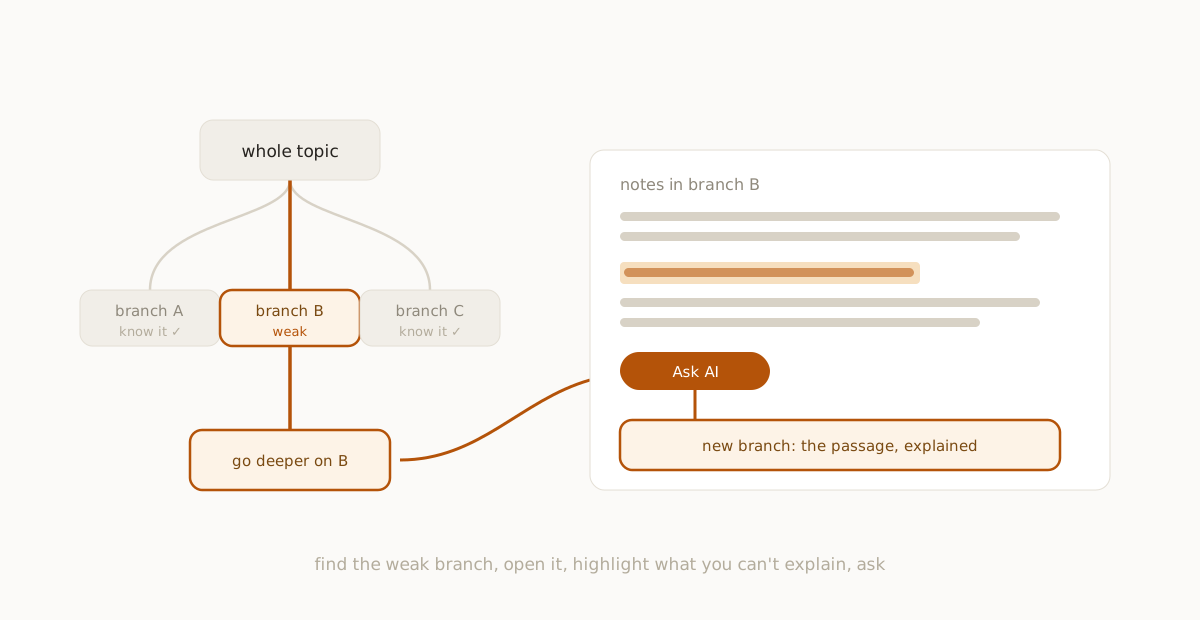
Step 1: Sort the branches
Look at the main branches only. For each one, without opening it, say aloud what it covers. Then give it a label:
- Solid: I could explain this to a friend.
- Shaky: I know some of it.
- Blank: I could not start.
Be strict. If you are not sure, it is shaky. This takes about five minutes and it is the most useful five minutes of the session, because it replaces a feeling with a list.
Step 2: Write the answer before you look
For each shaky or blank branch, close the notes. Try to write or say everything you can remember about it. It will be messy and short. That is fine.
This is retrieval practice, and there is research behind it. In a 2006 study in Psychological Science, Roediger and Karpicke had students study short prose passages, then either re-read them or take free-recall tests. On a test five minutes later, re-reading did better. On tests two days and a week later, the students who had been tested remembered substantially more. The study used reading passages, not exam subjects like yours, so treat it as a reason to try this, not a promise. The abstract is on PubMed.
Step 3: Open the weak branch
Now open the branch and compare. Where your answer was missing something, read that part closely.
When a line does not make sense, do not reread it three times. Highlight it and use Ask AI in fork ai. You can ask what it means, why it is true, or for a plainer example. The answer becomes a new branch attached to that passage, so you can find it later.
Good questions to ask on a highlighted passage:
- "Explain this like I am meeting it for the first time."
- "Why does this happen, and what would change if it did not?"
- "Give me a worked example with numbers."
- "What is the difference between this and the idea just before it?"
If the whole branch is thin, use Go deeper on its section to get a node of its own.
Step 4: Close it and try again
After you have read the answer, shut the branch and write the explanation again, in your own words. If you can do it, mark the branch solid. If not, ask about the part that stopped you.
fork ai does not make flashcards or quizzes. The testing is you, writing from memory, with the branch as the answer key. That is slower than tapping a card, and it works the part of your memory that the exam will use.
Step 5: Cross-check against the source
An AI explanation can be wrong. It can also say things your lecturer would not. For anything you will be marked on, check it against the slides, your textbook or your own notes before you trust it. The map is a way to find your gaps quickly. Your course material is still the authority.
A simple plan for one evening
- Sort the branches into solid, shaky and blank. (5 minutes)
- Pick the two weakest. For each, write what you can from memory. (10 minutes)
- Open each one, highlight what you could not explain, and ask. (20 minutes)
- Close and explain it again. (10 minutes)
- Next day, start from the map again and test the same two branches before moving on.
Spacing the second look over a day or more is the other half of the method. It is easy to skip, so put it in your calendar.
What this will not do
It will not tell you what your examiner will ask. It will not read the diagrams in your slides. It will not make you remember anything for you. The map tells you where to look. The remembering is still your job.
If you want the wider idea of why structure helps memory, see build a memory map and studying with AI.
Questions people ask
How long should a revision session on one map take? Short sessions work. One evening can cover two or three weak branches. Stop when you cannot explain a branch back, and ask about it next time.
Do I need to open every branch? No. That is the point. Open the shaky and blank ones. Leave the solid ones until you retest them.
Can I trust the AI answers on a branch? Use them as a first explanation and check exam material against your own course notes.
Can I do this on my phone? Yes. fork ai runs in a phone browser at forkai.in and is on iPhone.
Your next step
Once your map appears, do one thing. Pick the branch you labelled shaky, close the notes, write what you remember, then open the branch. That is a full revision loop, and it takes ten minutes.
fork ai turns any question into a branching map you can explore, highlight, and keep. Try it free.
Start researching →