Who Is the Xerox of the GPT World?
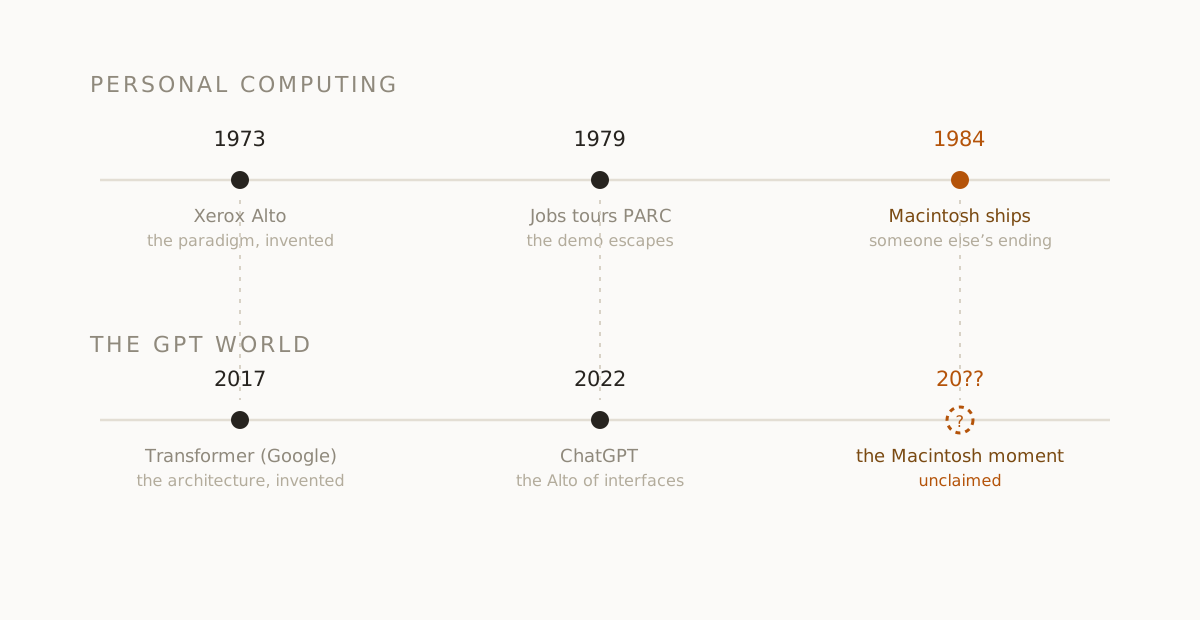
In 1979, Steve Jobs toured Xerox PARC and saw the Alto: a personal computer with a graphical interface, a mouse, ethernet, WYSIWYG editing. Xerox had invented essentially all of personal computing's next twenty years — and captured almost none of it. The Macintosh shipped the GUI to the world; Xerox shipped copiers. "The Xerox of X" has been shorthand ever since for the company that invents the future and hands it to someone else.
So, who is the Xerox of the GPT world? It's a sharper question than it looks, because the answer depends on which Xerox mistake you think is being repeated.
The obvious candidate: Google
The literal parallel is almost too clean. The transformer was invented at Google in 2017 — Attention Is All You Need is a Google Brain paper. Google had the architecture, the compute, the data, the talent, and even working chatbots years before ChatGPT. And it was OpenAI that took the invention, productized it, and defined the category in the public mind. Even the casual generic name — "the GPT world" — belongs to someone else. Eight authors of the transformer paper left; the invention walked out the door, just as PARC's researchers walked to Apple and Microsoft.
But the parallel breaks down on one point: Xerox never recovered, while Google is very much still in the fight, shipping frontier models of its own. Google played Xerox for five years, then refused to finish the script. Verdict: the closest Xerox, but not a completed one.
The subtler candidate: OpenAI itself
Here's the more interesting reading. PARC's deepest contribution wasn't a device — it was an interface paradigm. And the GPT era's interface paradigm, chat, was crystallized by OpenAI. ChatGPT was famously assembled in weeks as a "research preview"; the chat window was a demo wrapper around the model, not a considered thesis about how humans should work with machine intelligence.
That's the PARC pattern in miniature: invent something epochal, wrap it in the first interface that comes to hand. OpenAI's own launch post framed ChatGPT as a research preview, not a product thesis. The Alto's GUI needed Apple's obsessive refinement to become the Mac. Chat may be the GPT world's Alto — the proof of concept everyone copied, mistaking the demo for the destination. If the real GUI for LLMs looks like visible, branching, spatial work rather than a scrolling transcript, then whoever builds it plays Apple — and the inventor of chat risks playing Xerox at the interface layer even while winning at the model layer.
The candidates nobody mentions
The labs aren't the only ones auditioning for the role. Academia and open research invented attention mechanisms, RLHF's foundations, and scaling laws, and captured roughly nothing — though capture was never the point. Yahoo, Quora, Reddit, Stack Overflow spent two decades accumulating the question-and-answer corpora the models learned from; Stack Overflow watched its traffic become training data for its replacement. That's a crueller variant: Xerox at least got to see the Alto.
What PARC actually teaches
The standard moral — "execution beats invention" — is too thin. Xerox's real failure was a category error: it evaluated the Alto as a copier company evaluates products, and the future didn't fit the form. The GPT-world version of that error is evaluating everything by benchmark scores while assuming the interface question is settled. Model capability is racing toward parity; the durable differences are accruing in unfashionable places — how context gets assembled, how a session becomes an artifact you keep, how a person steers an inquiry rather than scrolls one.
History says the inventor of the engine and the owner of the experience are rarely the same company. IBM built the PC, Microsoft owned it. Xerox built the GUI, Apple owned it.
So, who is it?
Google is the Xerox of the architecture — the cleanest match on facts, saved only by its refusal to stay down. But the title for the paradigm is still open, because the GPT world hasn't had its Macintosh moment yet. We are in the interregnum: the Alto exists, everyone's copying it, and the interface that makes machine intelligence feel inevitable hasn't shipped.
Remember what PARC actually was, though, before the cautionary tale swallowed the rest of the story. It was a small group, nowhere near the biggest budget in computing, that looked past the dominant interface of its day and asked what working with a computer should feel like — then built it, years early, while the giants optimized the machines underneath. The tragedy wasn't the inventing. The tragedy was that the inventing happened inside a copier company that couldn't see it.
That first half of the story is the role fork.ai is playing on purpose. The labs are racing each other on the substrate — benchmarks, parameter counts, the engine. We think the open question is the one PARC answered for the last era: the paradigm. Our bet is that the scrolling transcript is the GPT world's terminal, and that the real interface is visible, branching, and spatial — every answer a node on a map, every question scoped to exactly the context it needs, every session an artifact you keep instead of a scroll you lose.
So yes: fork.ai should be the Xerox of the GPT world — the PARC half. The place where the interface paradigm gets invented while everyone else is staring at the engine. The only part of the script we're rewriting is the ending. Xerox invented the future and let someone else ship it; we intend to do both. The Macintosh moment has to come from whoever is obsessing over the experience while the rest of the field benchmarks the substrate — and we'd rather be the ones demoing the Alto than the ones touring the lab.
Sources: Malcolm Gladwell, “Creation Myth” (The New Yorker, 2011); Michael Hiltzik, Dealers of Lightning: Xerox PARC and the Dawn of the Computer Age (1999); Ashish Vaswani et al., “Attention Is All You Need” (NeurIPS, 2017); OpenAI, “Introducing ChatGPT” (2022).
fork ai turns any question into a branching map you can explore, highlight, and keep. Try it free.
Start researching →