fork ai vs mindmap.io: AI Research Map vs Static Mind Map
Mind mapping tools like mindmap.io, Miro, and Mural have been around for decades. They give you a blank canvas to place nodes, draw connections, and arrange ideas visually. Fork ai looks superficially similar — it also produces a branching map — but arrives at that map from the opposite direction. Traditional mind map tools wait for you to bring the ideas. Fork ai generates them from your questions.
What a static mind map tool does
mindmap.io is a drag-and-drop canvas. You open it, create a central node, add branches manually, and type labels into each one. The tool is blank by design — it organises ideas you already have, in a structure you choose.
That makes it excellent for:
- Team brainstorming on a shared whiteboard
- Building visual structures for presentations
- Org charts, process flows, and project breakdowns
- Anything where the map itself is the deliverable
The limitation shows up in research. A blank canvas for a topic you don't understand yet is just blank.
What fork ai does instead
Fork ai starts with a question and generates a structured answer — multiple sections, each with a heading and body — in about ten seconds. From any section you can go deeper with one click, spawning a child branch that inherits the parent's context. Every branch generates more content, and the whole inquiry builds into a navigable map automatically.
You don't type node labels. You ask questions.
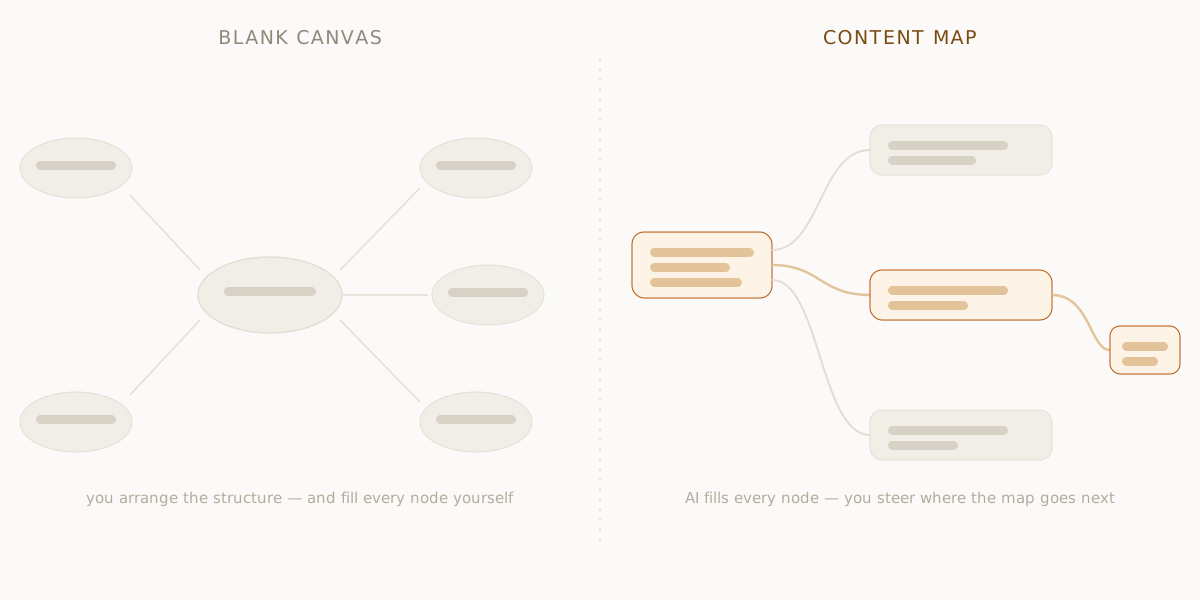
The key difference: who brings the content
In mindmap.io, you are the content. The tool structures what you type. It is a spatial writing and diagramming surface, not a research assistant.
In fork ai, the AI is the content. You contribute the questions and the steering; the model writes every node. The result is less like a diagram and more like a knowledge map — a spatial record of an inquiry, with real depth at every node.
Where mindmap.io wins
If you need a visual artifact to share with others — a project plan, a stakeholder map, a presentation diagram — mindmap.io is the right tool. You control every label and connection, and the output is arranged exactly as you designed it.
Fork ai's maps are for exploration, not presentation. They are generated, not curated.
Where fork ai wins
Any research session that starts with "I don't know enough about this yet" is where fork ai has an advantage. Instead of facing a blank canvas, you ask a question and get a structured starting point in seconds. Then you branch. Then you branch again. When you are done you have a second brain entry for this topic — not a diagram, but a record of what you learned, exportable to Notion.
| mindmap.io | fork ai | |
|---|---|---|
| Generates content | ❌ | ✅ |
| Branching from AI answers | ❌ | ✅ |
| Team collaboration | ✅ | ❌ |
| Manual node arrangement | ✅ full control | ❌ AI arranges |
| Export to Notion | ❌ | ✅ |
| Model choice | — | Claude / Gemini / DeepSeek / GLM |
| Best for | Organising, presenting | Researching, learning |
How most people end up using both
A common workflow: use fork ai to do the research and build understanding, then take the key ideas into mindmap.io or Miro to arrange them for an audience. The two tools solve different parts of the same problem. Fork ai fills your head; mindmap.io fills the slide.
FAQ
Is fork ai a mindmap.io alternative?
For AI-powered research and exploration, yes. For manual visual diagramming and team whiteboarding, mindmap.io is purpose-built for that and remains the better choice.
Does fork ai generate real mind maps?
Every fork ai session builds a live branching map automatically from your questions and the AI's answers. Unlike a traditional mind map, every node contains generated content — not just a label you placed.
Can I control the layout in fork ai?
The layout is generated from the branching structure of your inquiry. For presentations requiring precise visual control, export your session to Notion and use a dedicated diagram tool for the final layout.
What AI does fork ai use?
Your choice of Claude, Gemini, DeepSeek, or GLM per branch, with Claude Sonnet for the root question.
fork ai turns any question into a branching map you can explore, highlight, and keep. Try it free.
Start researching →